Tax Appeal Savings Calculator

Enter your current assessed value and your estimate of your home's true market value to see how much you could save annually — and over five years — by filing a successful property tax appeal.

By Rachel LiuUpdated April 20268 min read

Tax Appeal Savings Calculator

See how much you could save by appealing your assessment

Your Assessment
Updated 202650 States + DCFree to Use
Disclaimer: This calculator provides estimates for educational and informational purposes only, using publicly available data from the Tax Foundation, U.S. Census Bureau, and state assessor offices. This is not tax, legal, or financial advice. Actual property taxes depend on your specific local jurisdiction, tax district, exemptions, and current mill levies. Always consult your county assessor, tax collector, or a qualified tax professional for exact figures and advice specific to your situation. We do not store, collect, or retain any data you enter into our calculators — all calculations are performed locally in your browser. TaxAssessmentCalculator.com and its contributors assume no liability for decisions made based on calculator results.
Need Help With Your Property Tax Appeal?

Get connected with licensed tax professionals in your area — free, no obligation.

Why Property Tax Appeals Are Worth Your Time

Property tax assessments are not infallible. According to the National Taxpayers Union Foundation (NTUF), an estimated 30% to 60% of all properties in the United States are over-assessed. Assessors use mass appraisal techniques to value thousands of properties at once, and errors in square footage, outdated comparable sales data, missed depreciation, and neighborhood-wide over-valuations can all push your assessed value above what your home is actually worth.

The financial stakes are significant. Even a modest 10% reduction in assessed value on a $350,000 home in a state with a 1.5% effective rate translates to $525 in annual savings — over $2,600 across five years. According to Tax Foundation data, homeowners in New Jersey (2.23% effective rate) or Illinois (2.08% effective rate) could save several thousand dollars per year from a successful appeal.

According to research by the NTUF, homeowners who file formal property tax appeals succeed in winning reductions approximately 30% to 60% of the time, depending on the jurisdiction and the quality of evidence presented.

Step-by-Step: How to Appeal Your Property Tax Assessment
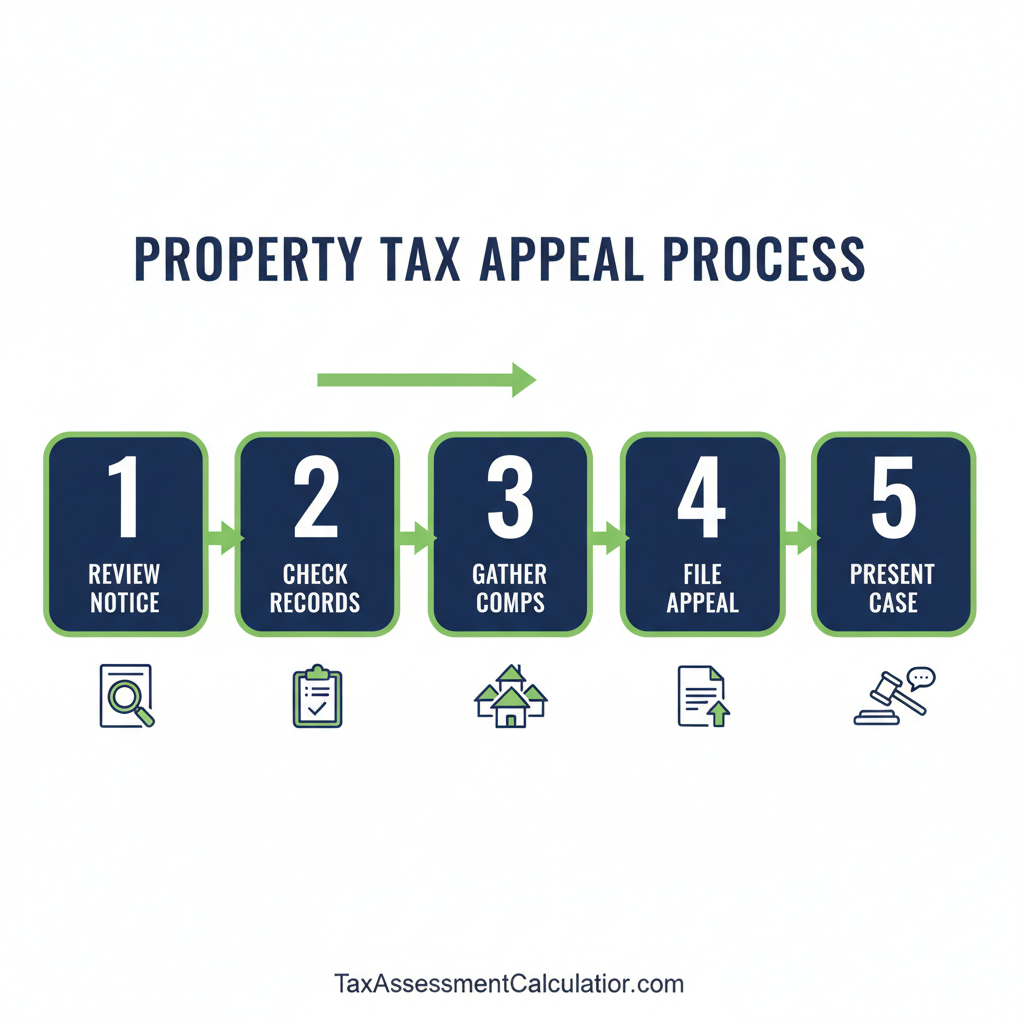
Five-step property tax appeal process infographic showing: 1. Review Notice, 2. Check Records, 3. Gather Comps, 4. File Appeal, 5. Present Case, with icons for each step
The property tax appeal process follows five key steps, from reviewing your notice to presenting your case.

Step 1: Review Your Assessment Notice

When you receive your annual assessment notice, compare the assessed value to what you believe your home would sell for in the current market. According to the International Association of Assessing Officers (IAAO), an assessment that exceeds market value by more than 10% generally warrants further investigation. If the gap is 5-10% or more after applying your state's assessment ratio, an appeal is likely worthwhile.

Step 2: Check Your Property Record

Visit your county assessor's office or website to review your property record card. According to the IAAO, common errors that inflate assessments include incorrect square footage, lot size, number of rooms, construction quality ratings, and inaccurate improvement records. The National Taxpayers Union recommends reviewing the property record as the first step in any appeal — simple data corrections are the easiest appeals to win.

Step 3: Gather Comparable Sales

Find 3-5 homes similar to yours that sold recently (within the last 6-12 months) for less than your assessed value. According to property tax attorney guidelines published by the American Bar Association, the strongest comparables match your home in size, age, condition, and location within a half-mile radius. Adjust for differences — a comparable with a renovated kitchen might justifiably sell for more, and you need to account for that in your analysis.

Step 4: File by the Deadline

Every state has a specific deadline for filing property tax appeals, and missing it means waiting another full year. According to state assessor offices, deadlines range from as early as 15 days after the assessment notice (Mississippi) to as late as December 31 of the assessment year (Oregon). In Texas, the deadline is May 15 or 30 days after the notice, whichever is later, according to the Texas Comptroller. In New Jersey, according to the NJ Division of Taxation, appeals must be filed by April 1 (or May 1 in revaluation years).

Step 5: Present Your Case

Start with an informal meeting with the assessor when possible. According to the Lincoln Institute of Land Policy, many jurisdictions resolve 40% to 70% of assessment disputes at the informal review stage without requiring a formal hearing. If the informal review doesn't result in a satisfactory reduction, proceed to the formal appeal hearing with your evidence organized and presented clearly.

When to Hire a Professional
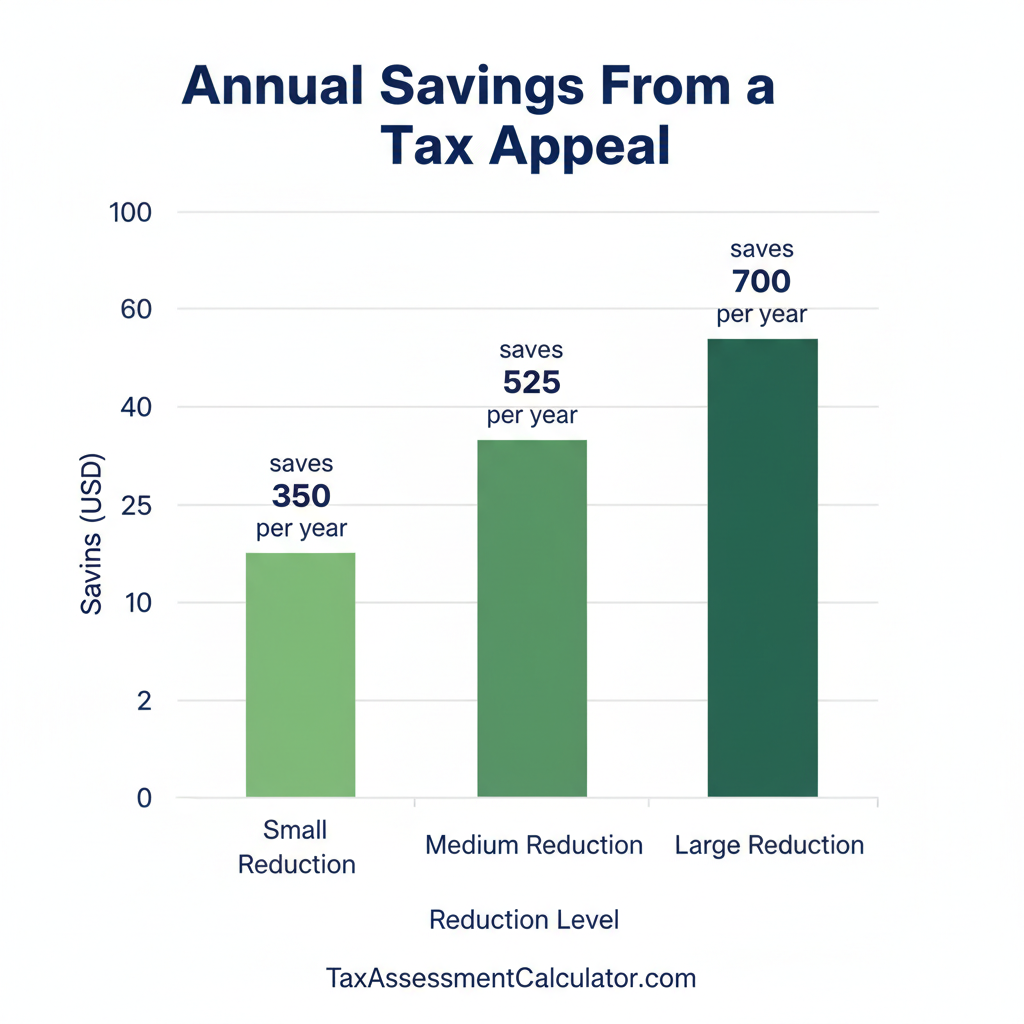
Bar chart showing potential annual savings from a property tax appeal, with small reductions saving $350 per year, medium reductions saving $525, and large reductions saving $700 at a 1.5% tax rate
Even modest assessment reductions can save hundreds per year in property taxes.

For most homeowners, a self-filed appeal is sufficient — especially if you have strong comparable sales data and a clear error in your assessment. However, hiring a property tax consultant or attorney makes sense when the potential savings are large (over $2,000 per year), your case involves complex valuation issues, or you're uncomfortable presenting before a review board.

According to the National Association of Property Tax Attorneys, many tax professionals work on contingency, typically charging 25% to 50% of the first year's tax savings. This means you pay nothing if the appeal is unsuccessful, and the professional has a strong financial incentive to win your case.

State-by-State Appeal Deadlines

Timing is critical in property tax appeals. According to state assessor and comptroller offices across the country, the window to file is often short — sometimes as few as 15 days from the date of your assessment notice. Here are the most common deadline structures:

Deadline TypeStatesTypical Window
Days after noticeAL, AK, DE, GA, MT, NC, NM, OK, VT, VA15-90 days
Fixed calendar dateCA, CO, IA, KS, NE, NV, NY, OH, OR, WASpecific month/day
Board meeting dateMI, MN, MO, ND, SD, TN, WIAnnual board session
Varies by countyPA, VACheck locally

Sources: State assessor and comptroller offices; compiled from individual state statutes and administrative rules.

Frequently Asked Questions

How do I know if my property is over-assessed?
Compare your assessed value to recent sale prices of similar properties in your neighborhood. If your assessment is significantly higher than what comparable homes have sold for, you may be over-assessed. You can also compare your assessment ratio to your state's target ratio using our Assessment Ratio Calculator.
What evidence do I need for a property tax appeal?
The strongest evidence includes recent comparable sales (homes similar in size, age, condition, and location that sold for less than your assessed value), an independent appraisal, photos documenting property defects or needed repairs, and data showing assessment inequities among similar properties in your area.
How much does it cost to appeal property taxes?
Filing a property tax appeal is typically free at the local level (Board of Review or Board of Equalization). If you escalate to a state tax tribunal or hire a professional, costs can range from $200 to $500 for filing fees and $300 to $3,000 for professional representation. Many tax attorneys work on contingency — they only get paid if you win.
What is the success rate for property tax appeals?
Success rates vary by jurisdiction, but studies suggest that homeowners who file appeals win reductions 30% to 60% of the time. The odds improve significantly when you present strong comparable sales data and can demonstrate clear over-assessment relative to the market.
How long does the appeal process take?
A typical appeal takes 2 to 6 months from filing to resolution. Informal reviews with the assessor can be resolved in weeks. Formal hearings before a local board usually take 1-3 months. State-level appeals can take 6-12 months or longer.
Will appealing my property tax raise my assessment?
In most states, your assessment cannot increase as a result of your appeal. However, your regular scheduled reassessment could still result in an increase independently. A few jurisdictions reserve the right to review the entire property during an appeal, which theoretically could lead to an increase if the property was previously under-assessed — but this is rare.
RL
Rachel Liu
Property Tax Research Analyst

Rachel Liu is a property tax researcher with over 12 years of experience analyzing real estate taxation across the United States. After working in tax administration and real estate finance, she built TaxAssessmentCalculator.com to make publicly available tax data accessible to everyday homeowners. Her research draws from the Tax Foundation, U.S. Census Bureau, and state assessor offices across all 50 states.

Disclaimer: This calculator provides estimates for educational and informational purposes only, using publicly available data from the Tax Foundation, U.S. Census Bureau, and state assessor offices. This is not tax, legal, or financial advice. Actual property taxes depend on your specific local jurisdiction, tax district, exemptions, and current mill levies. Always consult your county assessor, tax collector, or a qualified tax professional for exact figures and advice specific to your situation. We do not store, collect, or retain any data you enter into our calculators — all calculations are performed locally in your browser. TaxAssessmentCalculator.com and its contributors assume no liability for decisions made based on calculator results.