What Is an Assessment Ratio?
The assessment ratio is the percentage of a property's market value that your local government uses to calculate the assessed value for tax purposes. According to the Lincoln Institute of Land Policy, assessment ratios are established by state law and are intended to ensure uniform taxation across all property types within a jurisdiction.
In states with a 100% assessment ratio (like California, Florida, and New York), the assessed value should equal the full market value. According to the Tax Foundation, states with the lowest ratios include South Carolina at 4% and Colorado at 6.55% — where the assessed value is a small fraction of what the home would sell for. Understanding your state's target ratio is critical because if your actual ratio is significantly higher, you may be paying more than your fair share.
Assessment Ratios by State
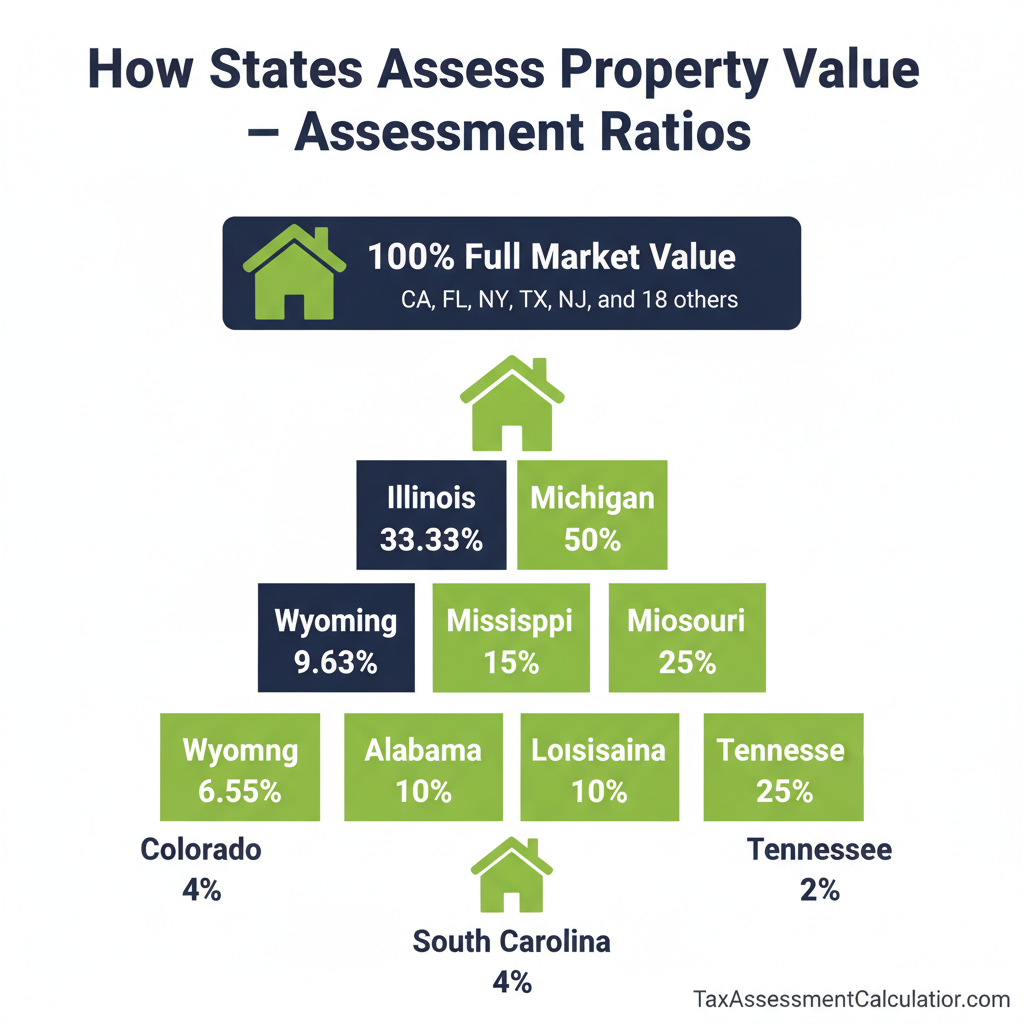
According to data compiled from state assessor offices and the Tax Foundation, assessment ratios range from 4% to over 100% across the country:
States with Low Assessment Ratios
| State | Assessment Ratio | Meaning |
|---|---|---|
| South Carolina | 4% | A $300,000 home has a $12,000 assessed value |
| Colorado | 6.55% | A $300,000 home has a $19,650 assessed value |
| Wyoming | 9.63% | A $300,000 home has a $28,890 assessed value |
| Alabama | 10% | A $300,000 home has a $30,000 assessed value |
| Arizona | 10% | A $300,000 home has a $30,000 assessed value |
Sources: State assessor offices; Tax Foundation; Lincoln Institute of Land Policy, Significant Features of the Property Tax.
States with 100% Assessment Ratios
According to the Tax Foundation, 23 states and the District of Columbia assess residential property at full market value (100% ratio), including Alaska, California, Florida, Idaho, Indiana, Kentucky, Maine, Maryland, Massachusetts, Minnesota, New Hampshire, New Jersey, New York, North Carolina, Oregon, Pennsylvania, Rhode Island, South Dakota, Vermont, Virginia, Washington, and Wisconsin. In these states, your assessed value and market value should theoretically be the same.
How to Use Your Assessment Ratio
To check if your assessment is fair, divide your assessed value by your home's estimated market value. According to the International Association of Assessing Officers (IAAO), an assessment is generally considered equitable if the actual ratio falls within 10% of the state or jurisdiction's target ratio.
For example, according to the Illinois Department of Revenue, the state's residential assessment ratio is 33.33%. If your home is worth $300,000, your assessed value should be approximately $100,000. If your assessment notice shows $115,000, that represents an actual ratio of 38.3% — well above the target. According to Tax Foundation data, at Illinois's 2.08% effective rate, that $15,000 in excess assessed value translates to roughly $312 in extra taxes per year.
Why Assessment Ratios Matter for Appeals
Assessment ratio analysis is one of the strongest legal tools in a property tax appeal. According to the IAAO's Standard on Ratio Studies, state constitutions and statutes in all 50 states require uniform assessment — meaning all properties of the same class should be assessed at the same ratio. If you can demonstrate that your property is assessed at a higher ratio than comparable properties, you have a strong legal argument for reduction, even if the underlying market value is accurate.
This legal theory is called an "equalization" or "uniformity" argument. According to property tax case law compiled by the National Conference of State Legislatures (NCSL), courts and review boards take uniformity claims seriously because the U.S. Constitution's Equal Protection Clause and most state constitutions require equal treatment in taxation. If your neighbors' homes are assessed at 95% of market value and yours is assessed at 110%, you may win a reduction even without disputing the market value itself.